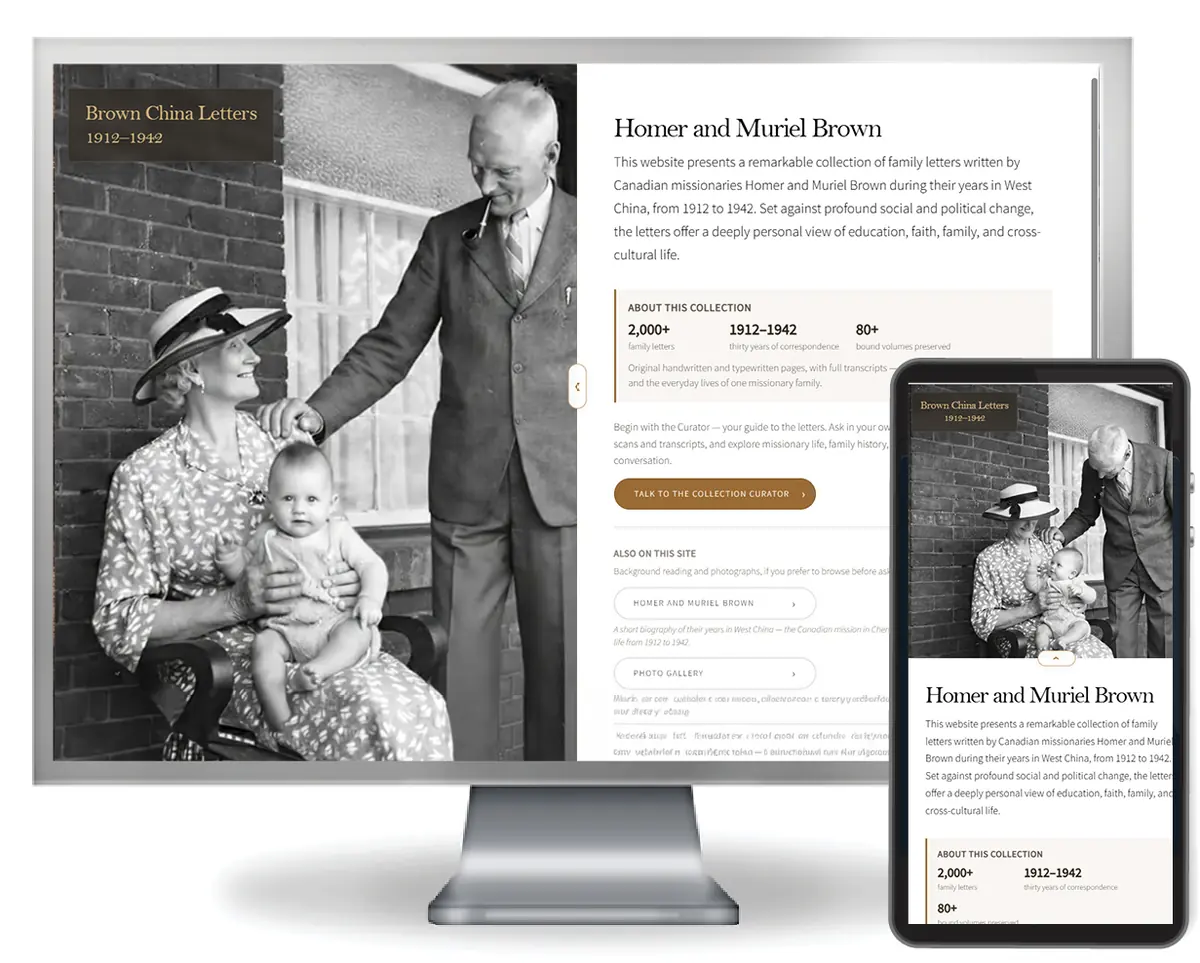
Featured case study
Brown China Letters.
2,000 letters. Three decades. One living archive.
From 1912 to 1942, Homer and Muriel Brown wrote home from West China. We turned that family correspondence into an intelligent digital collection — searchable, multilingual, and ready for the next generation of readers.
Visit the site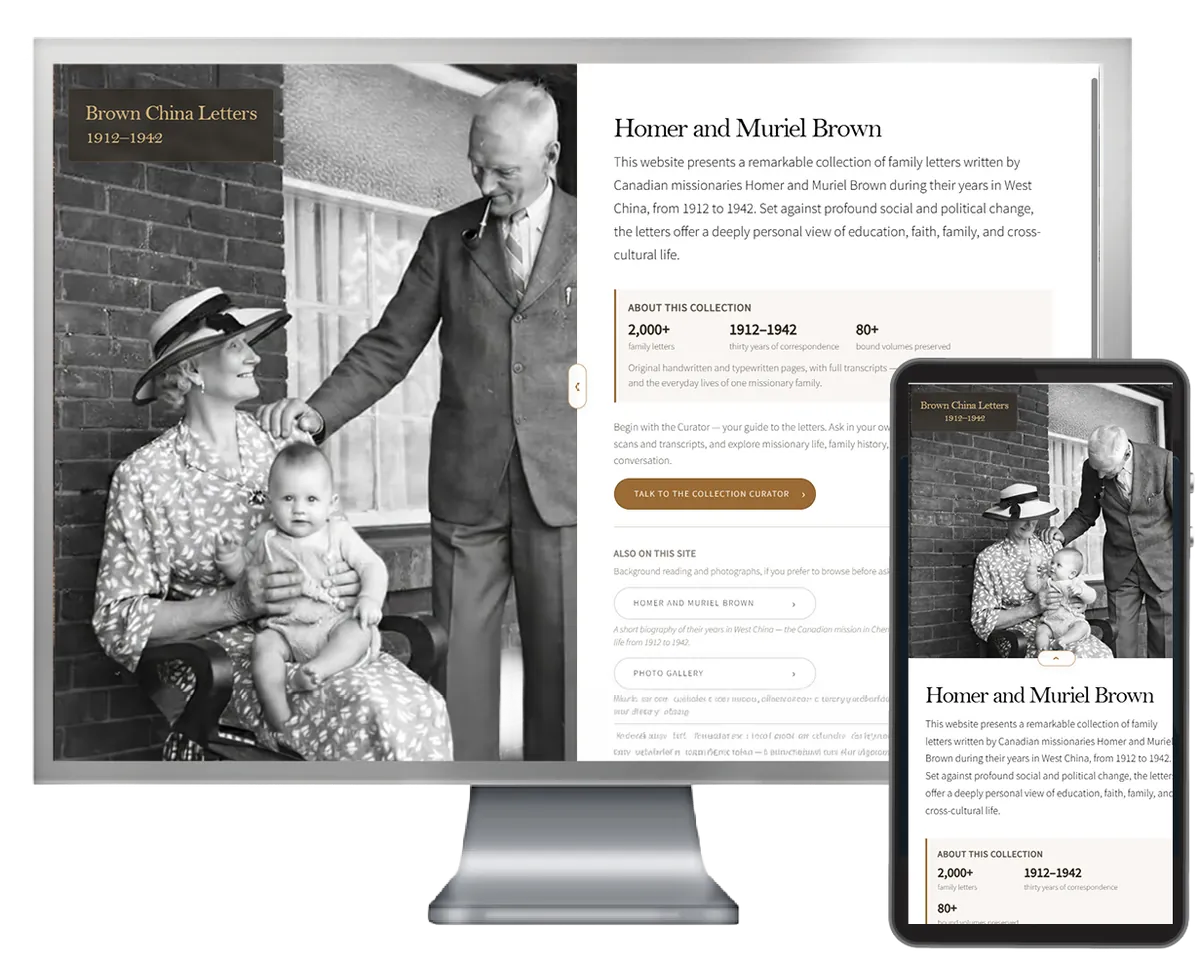
More ways we can help
The challenge
An extraordinary family archive landed on our desk: more than 2,000 letters exchanged between a family in Canada and Homer and Muriel Brown — grandparents who served as Canadian missionaries in West China.
Written across three remarkable decades, the letters document family life, education, faith and everyday experiences against a backdrop of enormous social and political change.
The original idea was straightforward — create a blog post for each letter and add a search box.
We knew this collection deserved much more.
What we built
Working with DeepThought AI — the intelligence behind Ask the Curator — we transformed the archive into a searchable collection rather than simply a website containing thousands of documents.
Visitors can explore and filter the letters, or ask a question in everyday language. The system searches across the collection, provides a relevant answer, and takes the visitor directly back to the original historical letter behind that response.
Ask in English, Chinese or any other language: the Curator replies in the language of the question.
Behind the experience is carefully structured data, strong technical development and search-ready coding designed to help both traditional search engines and emerging AI platforms understand the collection.
The result
What began as an idea for a letter-by-letter blog became a living digital archive — accessible to family members, historians, researchers and anyone curious about life in West China during this period.
And it is already being discovered beyond the website itself. Google's AI results are identifying and describing the Brown China Letters collection, while the archive is receiving searches and questions in Chinese — exactly the kind of reach the original collection could never have achieved sitting quietly in boxes.
And the story is still growing. Family members are now curating photographs from the archive, which will be added to the site as the collection continues to develop.
Best on desktop. Ask the Curator, letter filtering and the full archive were built for a wide screen — open the site there for the complete experience.